
A bad configuration line can be worse than a failed build. If the build stays green while ignoring the setting, you usually discover the mistake in a generated native project or on a device.
PR #5586 moves 87 common Codename One build hints into Java’s type system. A misspelled hint is now an unknown annotation attribute. A wrong value type or unsupported option stops at compilation instead of traveling to the build server as an inert string.
This change is part of the native windows weekly release. It is available through the Codename One Maven repository, so existing projects need the repository and plugin repository entries shown at the top of that post.
Why build hints existed in the first place
The original Codename One build server changed frequently. We needed to expose a new Android, iOS, or packaging switch without waiting for every IDE plugin to ship an updated settings screen.
Build hints separated those two release clocks. The plugin could send an open-ended map of strings. A builder could start reading a new key immediately:
codename1.arg.<name>=<value>
That escape hatch still does useful work more than a decade later. It lets a CN1Lib contribute native dependencies and lets a project tune low-level output without a new plugin protocol for every option.
The cost is that neither Java nor the plugin knew what most of those strings meant. The prefix confused people. Names and capitalization had to be exact. Values with commas, semicolons, or XML had their own merge rules. A name that no builder read was accepted, uploaded, and discarded.
This line looks plausible:
# Accepted by the old path, but ignored by the Android builder
codename1.arg.android.minSdkVersion=24
The builder reads android.min_sdk_version, not android.minSdkVersion. The project asked for API 24, the build succeeded, and the request used the builder’s default.
The compiler now checks the common path
The same setting can live on the application’s main class:
import com.codename1.annotations.buildhints.Android;
import com.codename1.annotations.buildhints.AndroidMinSdk;
import com.codename1.annotations.buildhints.Build;
import com.codename1.annotations.buildhints.DesktopBuild;
import com.codename1.annotations.buildhints.DesktopTitleBar;
import com.codename1.annotations.buildhints.Ios;
import com.codename1.annotations.buildhints.ThemeMode;
import com.codename1.annotations.buildhints.Toggle;
import com.codename1.system.Lifecycle;

@Android(
        themeMode = ThemeMode.MODERN,
        minSdkVersion = AndroidMinSdk.API_24)
@Build(nativeTheme = ThemeMode.MODERN)
@DesktopBuild(
        titleBar = DesktopTitleBar.NATIVE,
        width = 1280,
        height = 800)
@Ios(
        themeMode = ThemeMode.MODERN,
        newStorageLocation = Toggle.ON,
        pods = {"Intercom", "AFNetworking"})
public class MyApplication extends Lifecycle {
}
minSdkVersion takes AndroidMinSdk, so an integer does not compile. titleBar takes DesktopTitleBar, so autocomplete shows the accepted values and a made-up constant fails at the same line.
Seven annotations cover the common groups: @Ios, @Android, @DesktopBuild, @Build, @Hardening, @IosPrivacy, and @OnDeviceDebug. Ten enums describe closed value sets. Open-ended values remain strings.
The builders did not need a replacement protocol. BuildHintAnnotationProcessor converts the checked declaration into the same key and string value they already consume. Old projects, older framework versions, and the build service keep speaking the existing wire format.
An unset annotation does not freeze a server default
The build service still needs room to change. An Android packaging default that made sense ten years ago might be wrong for the current Play Store.
That is why no annotation attribute has a meaningful default. An empty string, an empty array, zero, Toggle.DEFAULT, or an enum’s unset marker all mean that the application said nothing. The processor emits no hint, leaving the current builder default in control.
There are no boolean attributes. Consider an appBundle attribute with a Java default of false. The Android builder currently defaults that hint to true. Compiling false into every application would silently override the server even when the developer never selected it. Toggle.ON, Toggle.OFF, and Toggle.DEFAULT preserve all three states.
This keeps the reason build hints existed. The server can evolve without requiring a client release for every default change. The difference is that an explicit value can now be checked.
Arrays carry the merge rule
Complex values exposed another weak point in the string form. Some lists use commas, some use semicolons, and a CN1Lib may append its own entry to the application’s value.
An annotation expresses a hint that accepts library additions as an array:
@Ios(pods = {"Intercom", "AFNetworking"})
The hint metadata records the wire key, separator, and whether a CN1Lib may append. The processor and library merger use that metadata instead of maintaining separate hand-written separator lists.
A command-line -Dcodename1.arg.<name>=... override still wins. A CN1Lib can still append to a hint whose metadata permits library additions. Declaring the same hint in an annotation and codenameone_settings.properties is different: the build stops and names the duplicate rather than guessing which source you intended.
One catalog replaces five drifting descriptions
The old hint set was partially restated in the developer guide, the Settings tool, the simulator, the Maven plugin’s separator map, and an agent reference. Only 147 of roughly 520 names appeared in more than one of those places.
The annotations are now the source of truth for the 87 hints they expose. The remaining hints live in maven/build-hint-catalog, including dynamic families and build-service-only settings. Together they describe all 497 hints read by the builders. The generated developer guide table now contains 577 rows with type, default, and annotation columns.
The Settings tool reads the catalog instead of scraping an AsciiDoc table and guessing types from prose. It validates closed value sets and identifies hints owned by an annotation, so it cannot add a duplicate property behind your back.
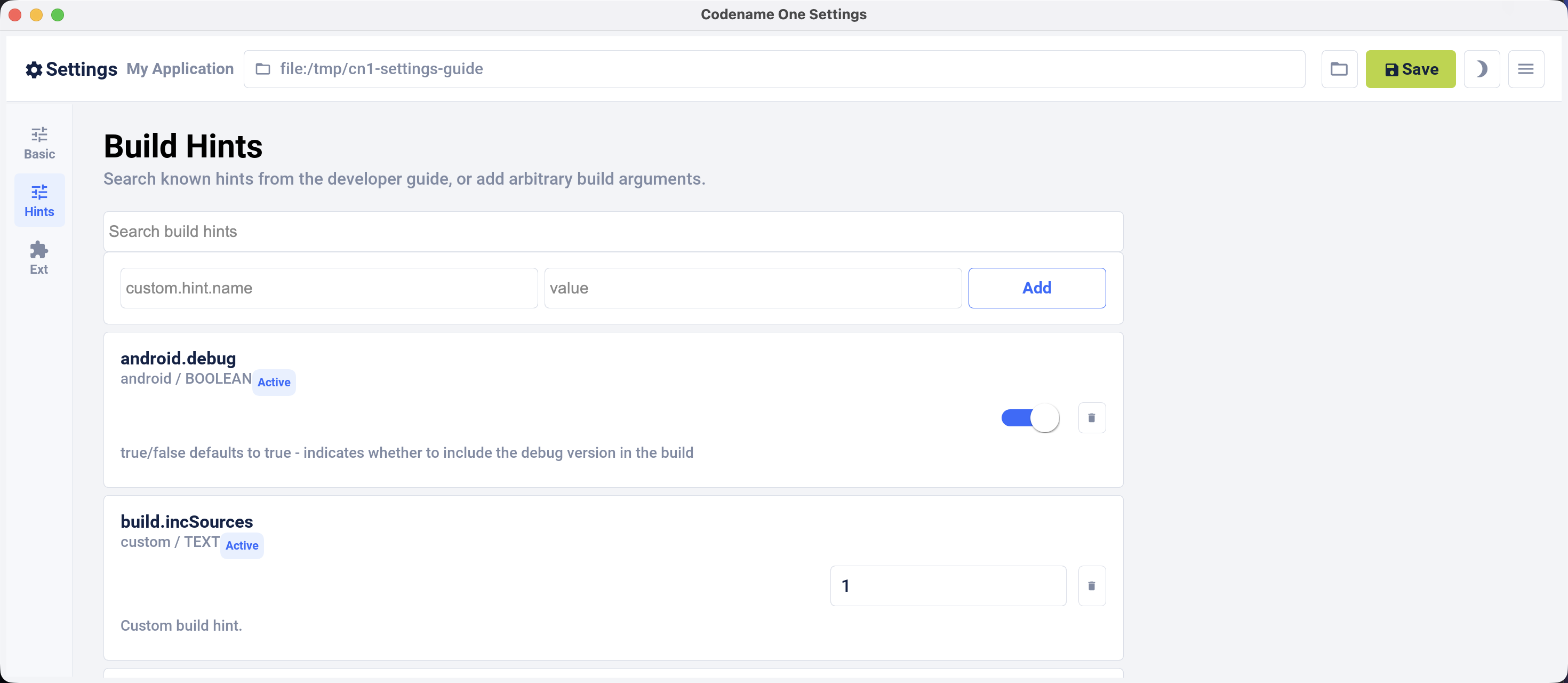
The properties editor remains available for the long tail. Its schema now comes from the same catalog as the guide and compiler tooling.
Two CI gates protect the catalog. One fails when framework code reads a hint the catalog does not describe, or when our documentation names a hint no builder reads. The second renders the annotation-backed editor and guide data to prove generation still produces the complete set.
Migrating an existing project
After updating the project POM and Codename One version, run:
mvn cn1:migrate-build-hints
The goal moves every property backed by an annotation when it can reproduce the value faithfully. That includes open-ended strings such as facebook.appId, gcm.sender_id, and ios.teamId. Hints without annotations, including dynamic families, stay in codenameone_settings.properties; values that cannot be translated without changing their meaning stay there too. The goal then runs the annotation processing path and verifies that every moved setting reached the generated manifest. If verification fails, it restores both files.
Older projects might not bind process-annotations to the module that compiles the main class. The build refuses to ignore the annotations and reports the missing execution. Add this to the Codename One Maven plugin configuration when needed:
<execution>
    <id>cn1-process-classes</id>
    <phase>process-classes</phase>
    <goals>
        <goal>process-annotations</goal>
    </goals>
</execution>
Some settings must remain properties. codename1.arg.java.version chooses the compiler that must compile the annotated class, so reading it from that class would be too late. Dynamic families such as android.permission.<NAME> also stay in the file because an annotation cannot expose an arbitrary map key.
Compile failures are the compatibility policy
The annotation form intentionally does not promise source compatibility for build hints. If a weekly release renames an attribute, changes its type, or removes an accepted value, the project stops compiling at the declaration. That is the desired failure mode.
The build service still accepts the old string protocol. An already-built project keeps building. If an annotation disappears and you need the previous spelling, the properties form remains available.
This matters most for settings that affect more than appearance. @Hardening and @IosPrivacy now make common security and privacy configuration visible to the compiler. A security setting that is misspelled is no security setting at all.
Start with mvn cn1:migrate-build-hints, review the generated annotations, and keep the properties that the goal leaves behind. The split is deliberate: checked declarations for the stable, common path and strings where the build still needs an open-ended escape hatch.
Discussion
Which build hint has been the easiest one to mistype or misunderstand in your projects?